
Reasons for sleeping on the floor: Coolness, safety and comfort
Many dogs choose the floor as their sleeping place because it is usually pleasantly cool there. Especially in warm weather or in poorly air-conditioned rooms, the floor can be a cooling retreat for the dog. This is particularly important for animals whose thermoregulation is more sensitive, or breeds with thick undercoats.
Special feature underfloor heating: Protection against overheating
What many people don't consider: In modern households with underfloor heating, the floor can become unpleasantly warm for the dog in winter. Dogs can only regulate their body temperature almost exclusively via their paws and by panting. Lying directly on the heat source can lead to heat accumulation. The KUDDE dog bed has an insulating effect here due to its special foam core. It shields the direct floor heat and ensures that your dog does not overheat, while at the same time being softly and joint-gently bedded.
In addition, the feeling of security plays a major role. Some dogs feel safer on the floor because they have a better view of their surroundings (strategic lying) or feel more stable in a stretched position on a hard surface. A preferred lying position or a habit from puppyhood can also lead to your dog preferring to rest on the floor.
From our experience, many dogs in such situations simply react to environmental stimuli. Understanding these reasons will help you better respond to your four-legged friend's needs.
Source: Thermoregulation in Canids: Young et al. (2012), Journal of Applied Animal Welfare Science; Behavioral studies on strategic resting place selection behavior.
Expert opinions and studies on the sleep behavior of dogs
Experts confirm that dogs adapt their sleep behavior depending on the season, health status and environment. Studies suggest that the change between different surfaces often serves thermoregulation. What we often hear is that dog owners are reassured by these insights because they understand that dogs are not fundamentally sick if they lie differently than usual.
When developing our KUDDE dog bed, it was important to us to take these natural needs into account: A stable sleeping option that, due to its materials (such as artificial leather), also has a temperature-regulating effect and at the same time offers orthopedic support.
Source: Zanghi et al. (2013), Journal of Veterinary Behavior: "Sleep and activity in dogs"; Study on the preference for sleeping places based on ambient temperature.
Orthopedic support through a dimensionally stable dog bed
For your dog to be able to sleep optimally, the right sleeping place is crucial. An orthopedic dog bed with memory foam, also called visco foam, like the KUDDE, offers your dog targeted stability and comfort. This viscoelastic memory foam adapts individually to the contours of your dog. It relieves the spine and distributes pressure points evenly, which ensures a healthy and relaxed lying position.
A crucial advantage: The thermal protective barrier An often underestimated factor for healthy sleep is the temperature of the surface. The KUDDE acts like an insulating layer in both directions due to its special, dense foam core:
-
Against cold from the floor: On cold tiles or in draughty corners, the bed prevents the cold from reaching the joints. This is essential for dogs with osteoarthritis, as cold can massively worsen joint stiffness and pain.
-
Against heat (underfloor heating): In modern households, the KUDDE protects against "heat accumulation" from below. While lying directly on underfloor heating stresses the dog's thermoregulation and can dry out the skin, the bed effectively shields the heat and ensures a constant, pleasant sleeping climate.
With the KUDDE, you can choose between two variants: KUDDE Standard with cold foam and KUDDE Special with memory foam as an additional layer in the lying surface. From our many years of experience, older dogs and those with orthopedic problems particularly benefit from the KUDDE. The dimensionally stable mattress helps to prevent muscle tension and promotes better regeneration during sleep.
We give a 10-year guarantee on the dimensional stability of the KUDDE dog bed because we are convinced of its durability.
Source: Biomechanical analysis of pressure distribution (spinal alignment) in veterinary orthopedics; Clinical standards for rehabilitation in osteoarthritis.
Why not all dog beds are equally good for the spine
Many dog beds feel soft, but often allow the spine to sink in (hammock effect), which can cause discomfort in the long run. This is particularly problematic for older or orthopedically impaired dogs.
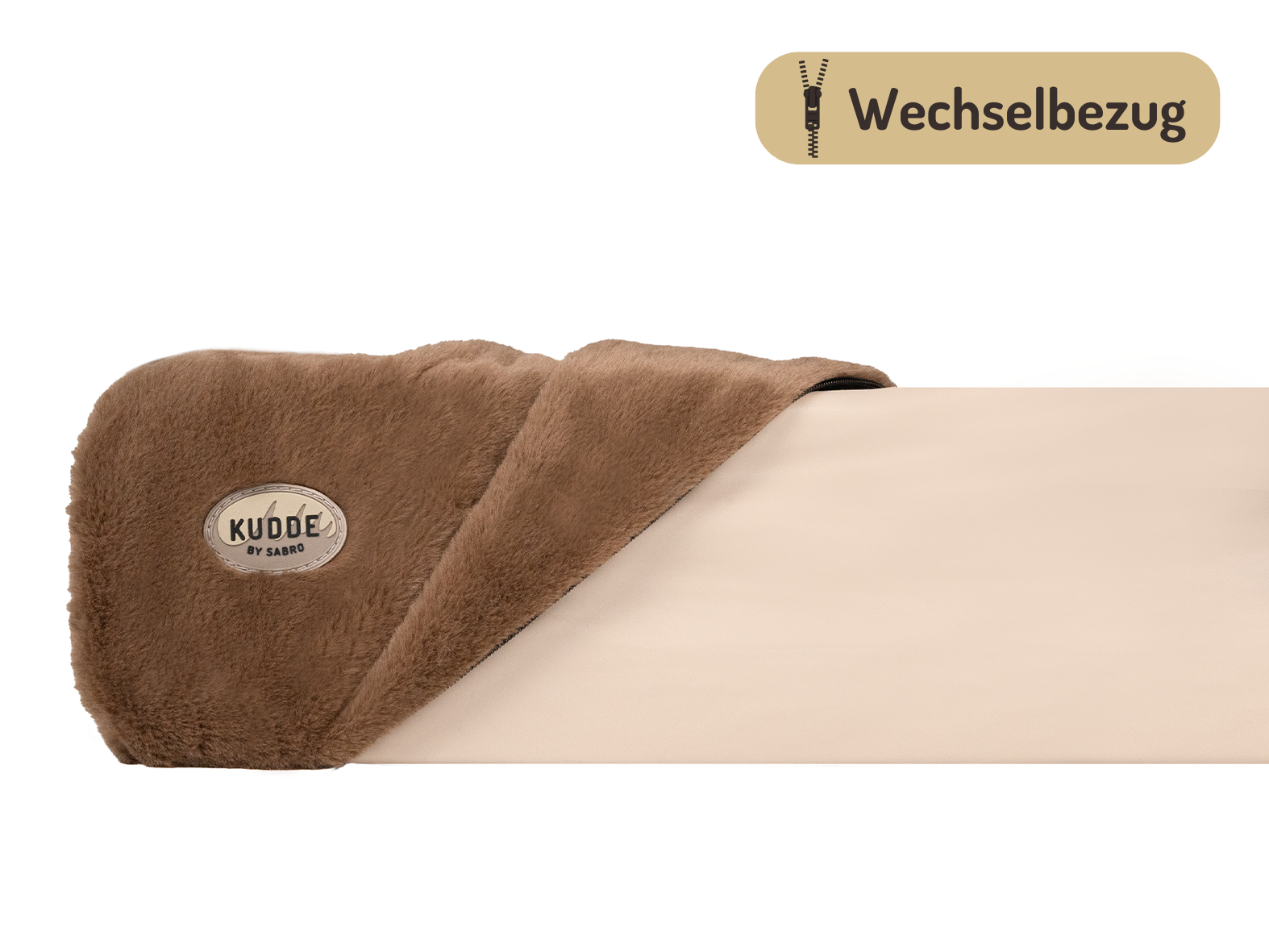
The KUDDE dog bed is characterized by its firm, yet comfortable core. This dimensional stability ensures healthy support and promotes the natural alignment of the spine. This also makes it easier for your dog to get up. The artificial leather covers are wipeable and durable (not washable), while the fabric variants are washable up to a maximum of 40°C. This keeps the bed hygienic and comfortable.

Source: Comparative study of polyurethane vs. visco foams in decubitus prevention; SABRO material testing for resilience.
Tips to motivate your dog to lie in bed
Sometimes it just takes a little patience to get your dog used to his dog bed. It is important never to force your darling. Use familiar blankets or toys and work with positive reinforcement. Place the bed in a quiet, protected place.
Many customers report that after an adjustment period, their dog enjoys using the bed, especially when he realizes that it offers him more comfort and thermal insulation than the hard floor.
Source: Learning behavior and positive conditioning: Schilder & van der Borg (2004), Applied Animal Behaviour Science.
Conclusion
Sleeping on the floor is usually no cause for concern, but often reflects the desire for coolness, safety or individual comfort. An orthopedic dog bed like the KUDDE supports your dog's health through its stable shape and high-quality memory foam, which keeps the spine straight and evenly distributes pressure points. This allows your dog to lie more relaxed and relieve joints and spine in the long term, for more quality of life even in old age. Of course, a dog bed does not replace veterinary treatment, but it can be valuable support.
Frequently asked questions about sleep behavior for dogs
Why does my dog sometimes prefer to lie on the floor than in bed?
Many dogs seek coolness on the floor, feel safer, or prefer certain sleeping positions. This behavior is often normal and says nothing about health. It can also depend on the season and environment.
Is it bad if my dog doesn't sleep in his dog bed?
No, not necessarily. As long as your dog shows no pain, avoiding the bed is usually not a problem. It is important to still offer him a comfortable and safe sleeping place.
How can I offer my dog a more comfortable sleeping place?
An orthopedic dog bed with memory foam (also called visco foam) that supports the spine and evenly distributes pressure can help. It is also important to place the sleeping place in a quiet and safe location and to make it a positive experience.
Why do some dogs prefer cool floors to sleep on?
Especially in warm weather, the cool floor helps to regulate body temperature. Older or sick dogs often react more sensitively to temperature and prefer to seek out cooler places.
How does an orthopedic dog bed help my dog with joint problems?
Orthopedic beds like the KUDDE relieve the joints and spine by evenly supporting the body and avoiding pressure points. This promotes more relaxed sleep and supports the regeneration of muscles and joints.
When should I worry if my dog avoids the bed?
If your dog shows pain, lameness, or noticeable behavioral changes, a visit to the vet is advisable. This can indicate health problems that should be treated.