
You, your dog, and the vastness of the mountains and forests: hiking has become a rediscovered leisure activity, especially in today's world. Plenty of fresh air, unforgettable adventures, and a good feeling despite tired legs. But especially if you want to take your four-legged friend on a hiking trip, there are a few things to consider. Just as you carefully pack your backpack for yourself, you also need to think about your dog. Here are our tips on "Hiking with a Dog."
Which dogs are suitable for hiking?
Ideally, you go hiking with active dogs who enjoy running, as are usually found among herding dogs and hunting dogs. Of course, we don't mean that it has to be a purebred dog; it can also be a mix. It's more about the body type of these dogs. A good guideline is the shoulder height: this should be at least in the middle range, i.e., over 30 cm. Very small, short-legged breeds (Dachshund, Chihuahua), as well as short-nosed dogs (Pug, French Bulldog), or very large breeds like St. Bernard, Great Dane can experience physical problems on long tours. As a rule of thumb: you know your dog and its activity best, so consider that in your planning.
The same applies to your dog's training: if he's a daredevil who doesn't listen well, you'll eventually have problems with other hikers. He should already master simple commands and obey them.
Is there a minimum age for dogs for outdoor tours?
For puppies and young dogs, long hikes are too much strain on their bones and joints. Therefore, we generally recommend a minimum age of one year, and for large breeds, at least 1.5 years. The growth phase should be completely finished. In the first year of life, you should only allow a young dog 5 minutes of active movement per month of life. A walk with a 6-month-old dog should therefore be around 30 minutes, with a 9-month-old dog about 45 minutes. Problem: your young dog will not "tell" you if it's too much for him, because he wants to stay with the pack and will try to keep "pace."
For senior dogs, the general fitness level and any existing illnesses need to be considered. If there are already problems such as back or hip ailments, it's better to spare your dog. Always plan hikes so that your dog can manage them, and prefer shorter rather than longer trips. A vet visit is also advisable before a big tour to get the "go-ahead" from the doctor.
What should a hike look like for my dog to enjoy it?
Holidays with a dog are comparable to holidays with a child. Parents will always put together a varied program for their offspring with playgrounds, relaxation on the beach or lake, etc. The same applies to your dog. Mere hiking will bore him sooner or later. So, ensure variety: plan your route along a mountain lake where your dog can cool off a bit in summer at suitable spots, provided the water looks good. Not to forget playing: the favorite ball absolutely belongs in your luggage and can provide a lot of fun off the hiking trail in large meadows or fields.
How do I prepare my dog and myself/us for the hike?
All participants in the hike should, of course, have a certain level of fitness. You can prepare well by gradually extending your walks and covering longer distances. Your dog should already be able to walk around 20 km on normal forest paths. Before you start the actual hike, the commands should be solid: practice laying down and recalling your dog during preparation.
To increase your dog's sure-footedness, you can use what's lying around in the forest: fallen trees or rock formations can give your dog a taste of the hiking adventure.
If the path gets narrow, it's better to let your dog walk behind you. Check if you can pick up and carry your dog without him wriggling wildly. Does your dog know free-roaming farm animals and how does he behave towards them? The more situations he knows, the more confidently he will master them on your hike.
Always ensure sufficient breaks and always have fresh water with you. Cycling with a dog can also be good preparation. However, be sure to observe our "Pro Tips for Cycling with a Dog" when doing so.
What should be in my dog's hiking gear?
A first-aid kit is very important, consisting of disinfectant, bandages, scissors, a muzzle sling, tick tweezers, etc. There are even special first-aid courses for dogs where you learn how to apply a paw bandage correctly or tie a muzzle sling.
It is also advisable to pack paw protection so that your dog can protect his paws if necessary, for example, when walking over sharper stones. It is best to practice walking with such shoes beforehand, as some dogs initially walk "as if on eggshells" and no longer put their paw down...
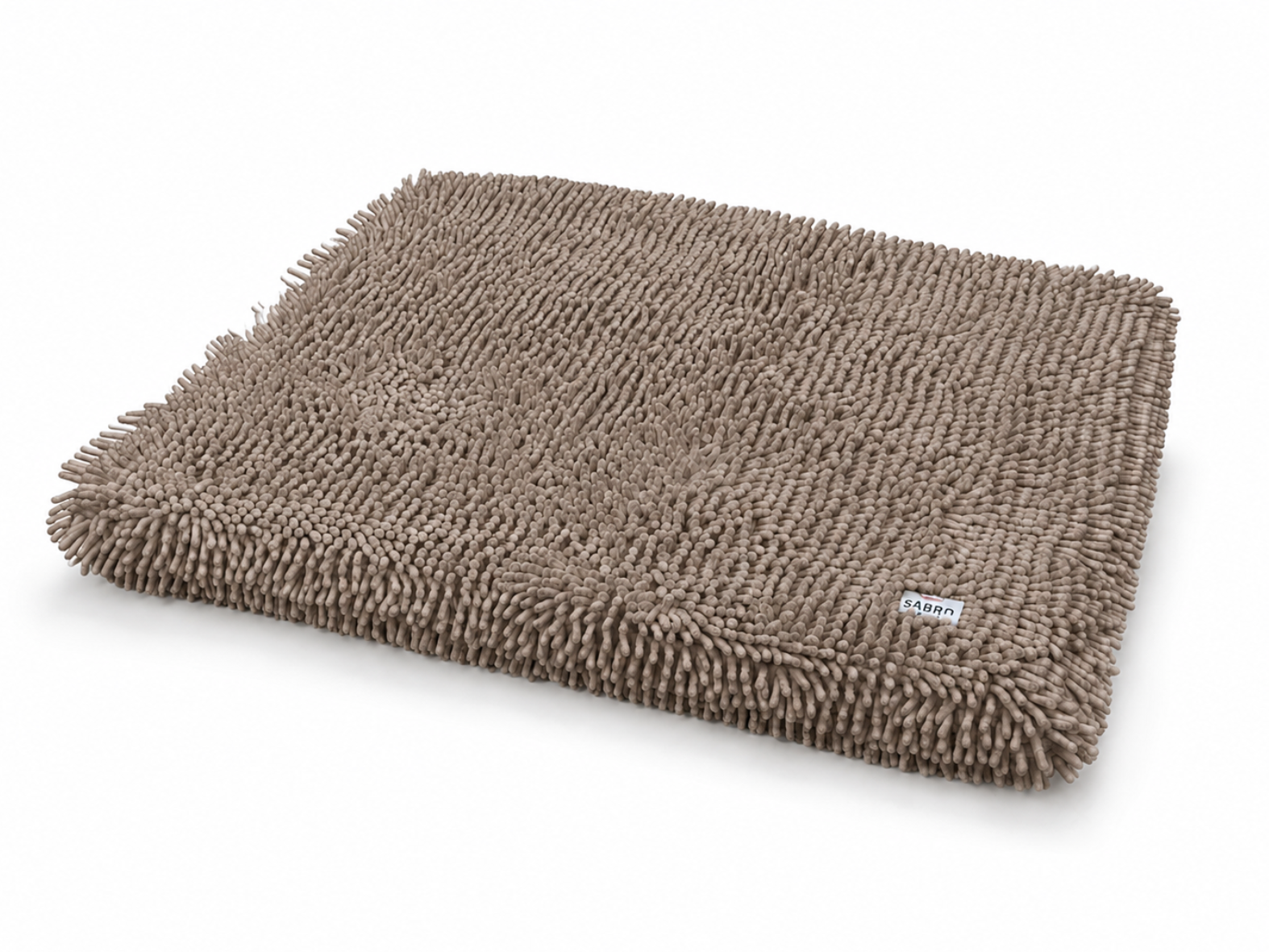
For a break during a picnic or as a sleeping place when you stop for the night, a travel dog mat is recommended.
To dry off after a voluntary or involuntary swim in a river or lake, you should definitely take a dog towel with you. And yes, you should also pack dog waste bags in your backpack so that your four-legged friend doesn't leave his droppings behind. Also a good idea are a ball for playing and your dog's favorite toy. And of course, water/food bowl and treats.
It is also worth taking a look at our category Dog accessories for on the go, where you will find everything you need for a safe and relaxed tour with your four-legged friend.
Which leash do you recommend for hiking with a dog?
On many paths, well-behaved dogs can run freely without a leash. Nevertheless, you should, of course, have a dog leash with you. Dragging and retractable leashes are not recommended, as they tend to get tangled and pose a danger, especially in unfamiliar and rough terrain. A collar can also be dangerous if your dog gets caught somewhere, for example.
It's best to choose a well-fitting chest harness and a short or adjustable lead leash.
Tip: if you have to cross a cow pasture with young animals, it's best to cross it quickly with your dog on a short leash. Mother cows are not to be trifled with when it comes to their calves. In case of an attack, it's best to unleash your dog immediately.
I need to stay overnight in a mountain hut, is that a problem with a dog?
First and foremost: before your hike, find out which huts are on your route and whether they allow dogs. Some guesthouses are now prepared for dogs as guests, but in real mountain huts and club huts, dogs are often not welcome, especially not in dormitories. If there's no other way, re-plan your tour so that it only passes huts that welcome dogs. When you are a guest, make sure your dog behaves well and politely.
Hiking with a dog: 9 tips for more safety on all trails
- When planning, check if the trail is dog-friendly and see where you might be better off taking a different route.
- Hike in the early morning and evening hours instead of in the midday heat, ideally in spring or autumn.
- Pack your dog's vaccination card and check for dog vets in the region where you are hiking beforehand.
- Prefer harnesses, as collars can strangle your dog in dense undergrowth.
- Always examine the path carefully to ensure sharp-edged stones do not injure your dog's paws.
- Make sure your dog does not drink from standing water on the path. Always give him enough drinking water in his bowl and take enough breaks so he can drink.
- When crossing pastures, keep an eye on cows, cattle, or sheep and cross green areas quickly with your dog on a leash. If possible, make a wide detour.
- Always pay attention to your dog's discipline, especially when wild animals are nearby.
- Observe if your dog lies down often or pants a lot. Both indicate overexertion; consider cutting the tour short.
Have you ever been on a hiking holiday with your dog or are you planning a tour soon? Leave us a comment and tell us how you prepare.